
FAQs
Find answers to the most common questions about Halfway Energy Park.
About Halfway Energy Park
1. What is Halfway Energy Park and who is developing it?
Halfway Energy Park is a proposed renewable energy development in the Carse of Gowrie in the Perth & Kinross Council area.
Halfway Energy Park is being developed by Halfway Energy Park Ltd, an Aukera Special Purpose Vehicle (SPV) established specifically to develop the project.
Aukera is a renewable energy Independent Power Producer (IPP) operating across the UK and Europe. We specialise in utility-scale solar, onshore wind and battery energy storage systems (BESS), and are actively involved at every stage of the project lifecycle. With 58.4MWp of renewable energy infrastructure already operational in the UK and a further 295.5MWp under construction, we are building a significant and growing presence with 60% of the pipeline located in Scotland.
Our team works from offices in Edinburgh and London, combining local expertise with national reach.
Beyond the UK, Aukera maintains an active development portfolio across Italy, Belgium, Germany, and Romania. Responsible development and genuine community engagement sit at the heart of everything we do, as we continue to invest in projects that support a sustainable, low-carbon energy future. Further information is available at: www.aukeraenergy.co.uk
2. Where is the proposed development located?
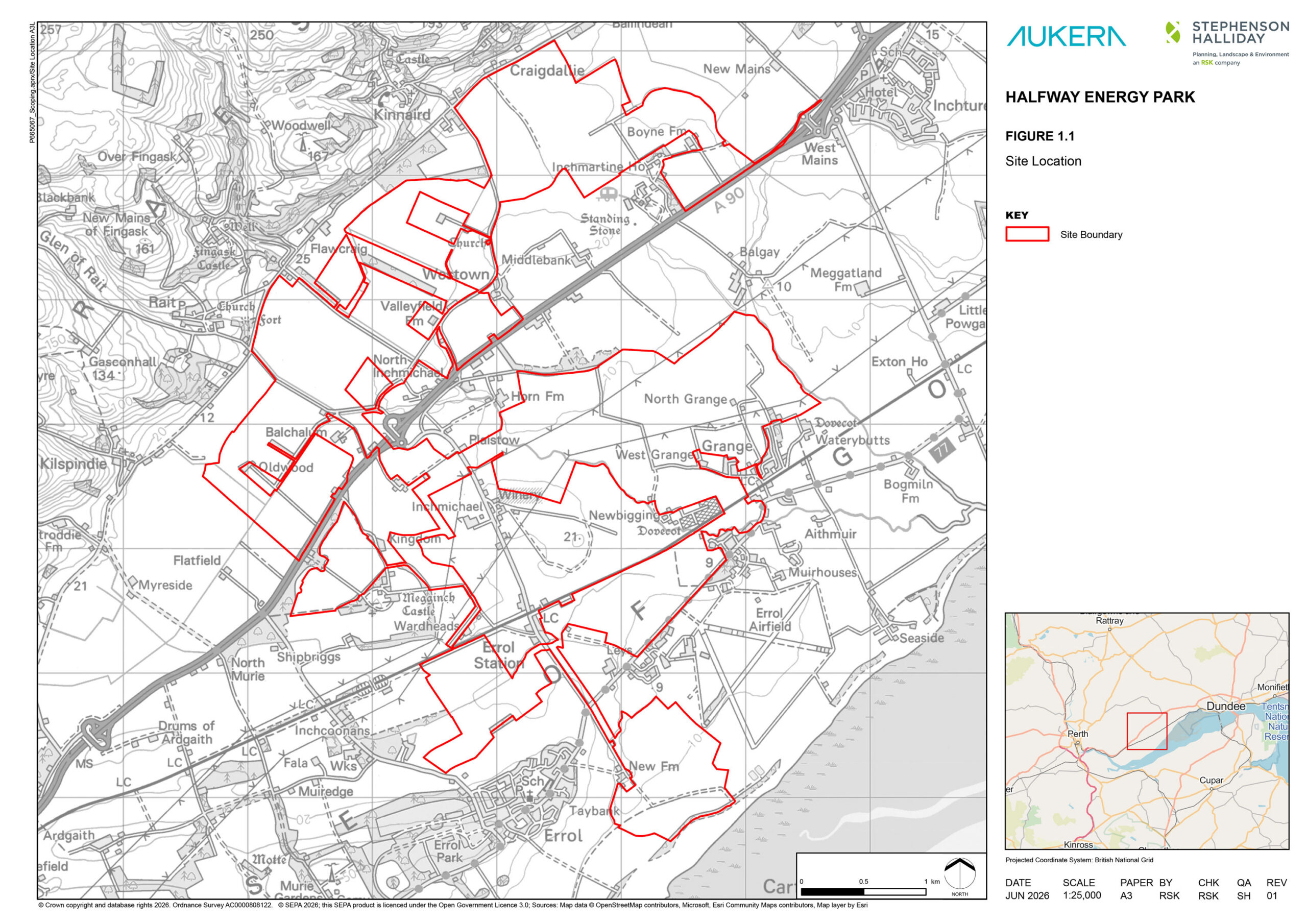
The site is located within the Carse of Gowrie, north of the River Tay, broadly between Inchture, Errol and Rait, in an area of predominantly lowland agricultural and grazing land.
The map can be found below:
3. Why is a project of this scale being proposed?
Halfway Energy Park is proposed at a scale that allows it to connect directly to the national high-voltage electricity transmission network. A project of this scale is required to make a transmission-level connection feasible and enables more efficient use of the available grid connection and associated infrastructure.
Developing at this scale also creates efficiencies in the amount of electricity that can be generated, the land required and the grid infrastructure needed, compared with developing multiple smaller projects with separate connections.
The proposed battery storage would also allow electricity to be stored and released when needed, helping to balance supply and demand on the grid. If consented, Halfway Energy Park would make a significant contribution to Scotland’s renewable electricity generation and energy security.
The project has also evolved as environmental and technical work has progressed. The wider site provides greater space and flexibility for landscape mitigation, biodiversity enhancement and other environmental measures, rather than simply accommodating solar panels. Over 400 acres are currently expected to be allocated for mitigation and environmental enhancement and this figure will be further refined as the design develops. These areas will be designed with input from the project’s landscape architects and ecologists, alongside advice from the James Hutton Institute on land management.
The Carse of Gowrie offers a great combination of suitable land, good levels of sunshine, excellent access and existing and planned electricity transmission infrastructure that can accommodate a project of this scale.
4. Is Halfway Energy Park the largest solar farm proposed in Scotland or the UK?
No. Halfway Energy Park is a large-scale renewable energy proposal, but it is not the largest solar development proposed in either Scotland or the wider UK. The UK Government’s Department for Energy Security and Net Zero (DESNZ) has approved several projects with a capacity over 500MW, which are now in the procurement and construction phases. In Scotland, a larger solar project has also been proposed in Dumfries and Galloway, which received its scoping opinion from the Scottish Government’s Energy Consents Unit in March 2026, although a formal consent application has not yet been submitted.
The Halfway Energy Park is proposed to provide up to 500MW of solar generation, alongside up to 100MW of battery energy storage. Its scale reflects the opportunity to connect to the high-voltage transmission network and make a significant contribution to Scotland’s renewable electricity generation and energy security.
5. Is Halfway Energy Park connected to plans for a data centre?
No. Halfway Energy Park does not include a data centre. The proposals are for solar photovoltaic generation, battery energy storage and the infrastructure required to connect the project to the electricity network.
6. Why has the Carse of Gowrie been chosen?
The Carse of Gowrie has been identified as a suitable location because it combines the land required for a project of this scale with access to existing and planned electricity transmission infrastructure. The site also provides opportunities to develop a sensitive design with mitigations for the landscape, as well as to deliver biodiversity enhancements and other environmental measures as the design develops. The Carse sits within the larger Central Belt of Scotland, an area which hosts the majority of Scotland’s population and is responsible for most of the country’s power demand.
7. Can electricity be generated from rooftop solar or smaller solar farms instead?
Rooftop solar and smaller solar developments have an important role to play in increasing renewable electricity generation, but they cannot meet all of Scotland’s future electricity needs on their own. Large-scale renewable projects are also needed to supply the wider electricity system, including essential services, infrastructure and industry.
If consented, Halfway Energy Park could generate renewable electricity equivalent to almost 5% of Scotland’s current annual non-domestic electricity demand. This includes the electricity used across businesses, industry and public services such as hospitals and schools.
Halfway Energy Park is designed to connect directly to the high-voltage transmission network, allowing renewable electricity to be generated at scale and supplied into the national electricity system.
8. Where will the electricity generated at Halfway Energy Park go?
The project is expected to connect to the electricity network via a new 400kV substation proposed by SSEN Transmission. As this is a transmission-scale connection, electricity generated by the project would become part of the national electricity supply.
Planning and consultation
9. Who will decide whether Halfway Energy Park is consented?
As the proposed generating capacity exceeds 50MW, the project requires consent under Section 36 of the Electricity Act 1989.
The application would be determined by Scottish Ministers through the Scottish Government’s Energy Consents Unit where Perth and Kinross Council would be a statutory consultee.
10. What stage is the project currently at and what happens next?
The project is at an early stage of development. A scoping request has been submitted to the Scottish Government’s Energy Consents Unit (ECU). Scoping allows the ECU and statutory consultees to advise on the environmental information and assessments that should be included in the Section 36 application as the project develops.
Site surveys and engagement with statutory consultees are ongoing. Public consultation drop-in events are taking place on 7th and 8th September and further events will take place in November 2026, giving local communities the opportunity to learn more about the proposals, meet the project team and provide feedback.
Following consultation, the project team will consider the feedback received alongside the findings from environmental and technical assessments and feedback from statutory and non-statutory consultees through the scoping process. The current programme anticipates that the final design and application will be prepared between November 2026 and March 2027, with an application expected to be submitted to the ECU in March 2027.
The timetable is indicative and may change as the project progresses.
11. How is the design being finalised and can feedback change the proposals?
We are consulting while the design is still developing so that community feedback can be considered and incorporated into the design alongside ongoing environmental and technical assessments.
Feedback from the first consultation will help inform areas such as the layout, landscaping and environmental mitigation. More detailed plans and visualisations will then be presented as the project develops, with a second round of consultation planned later in the year before the final application is submitted.
Landscape, homes and local amenity
12. How visible will Halfway Energy Park be and what will be done to reduce its potential visual impact?
The project will be visible from some locations, and reducing its visual impact is an important part of the developing design. Measures such as hedgerows, planting and other landscaping will be considered to help screen views from sensitive locations.
A detailed Landscape and Visual Impact Assessment, alongside residential visual amenity assessments looking specifically at potential effects on views and visual amenity from nearby homes, will inform the final layout and mitigation measures, with more detailed visualisations presented as the project develops.
13. How high will the solar panels be and how close could they be to homes?
The solar panels are currently anticipated to have a maximum height of 3.5 metres. The developing design also assumes a minimum 100-metre offset between solar panels and residential properties.
14. How will any potential glint and glare be assessed and managed?
It is anticipated that potential glint and glare effects can be addressed through the design of the project and appropriate mitigation measures. This will be considered as the layout is developed, with the aim of avoiding or reducing potential effects on nearby properties and other sensitive locations.
Where potential effects cannot be adequately addressed through design and mitigation, a full glint and glare assessment will be undertaken as part of the Environmental Impact Assessment.
15. Could the project affect the value of nearby properties?
We understand that property values are an important consideration for people living close to the proposed development. Property values are influenced by many different factors, and evidence from solar developments elsewhere in the UK does not appear to show a consistent impact on nearby property values.
As the project develops, potential effects on residential amenity, including landscape and visual impact, noise and traffic, will be carefully assessed. These assessments will help inform the final design and any appropriate mitigation measures.
Agriculture, ecology and landscape
16. What impact could the project have on agricultural land and farming?
The project would involve a temporary change in land use during its 40-year operational lifetime. The potential effects on agricultural land and farming will be considered as part of the Planning Statement accompanying the Section 36 consent application and will help inform the developing design.
Over the course of the project’s lifetime, there is also potential for ongoing monitoring of the land condition, recording changes to soils through the reduction in intensive farming and the use of chemical fertilisers.
Where practical, opportunities for continued agricultural use, such as sheep grazing between and beneath the solar panels, will be explored. At the end of the project’s operational life, the development would be decommissioned and the land restored to its original use.
17. What agricultural land classifications are present across the site?
Agricultural land in Scotland is graded according to its quality and suitability for different types of farming, with Grade 1 representing the highest-quality land.
Grade 2 and Grade 3.1 are classified as prime agricultural land, while Grades 3.2 and 4 have greater limitations and are not classified as prime agricultural land. Detailed assessment work is being undertaken with the James Hutton Institute at Invergowrie, which has specialist expertise in Scotland’s soils and agricultural land.
Current assessment of the wider site indicates that it contains a mixture of agricultural classes, from Grade 2 to Grade 4. This includes areas that are not proposed for solar panels, including land within the wider site being considered for mitigation and other purposes.
Grade 2 land has been avoided for solar development where possible, and the assessment will continue to inform the final project design and will be reported separately as part of the Section 36 consent application.
18. What impact could the project have on wildlife, birds and wintering geese?
Potential effects on local wildlife and biodiversity, including birds, are being carefully assessed through detailed ecological and ornithological surveys. This includes two years of surveys focused on wintering geese, reflecting the site’s location within the Carse of Gowrie and its proximity to the Tay Estuary.
19. What biodiversity and habitat improvements are being considered?
The project design will be landscape and ecology-led, with the aim of delivering significant biodiversity enhancements for local wildlife and habitats.
Enhancements currently being explored include:
- Native scrub thicket and individual tree planting;
- New species-rich and mixed native hedgerows with trees, alongside enhancement of existing hedgerows;
- Fruit trees and orchards, including apples, pears and soft fruit, reflecting the historic and wider character of the area;
- Species-rich grassland; and
- Measures to create suitable habitats to support and encourage local bird populations and pollinators.
These proposals will continue to be refined as the project design and ecological assessments develop.
20. How will potential flood risk and drainage be assessed and managed?
Potential flood risk and drainage are important considerations in the development of Halfway Energy Park and will be assessed as part of the Environmental Impact Assessment.
Detailed flood modelling is being undertaken to understand existing flood risk across the site and how the proposed development could interact with local watercourses and drainage. The findings will help inform the project layout and identify any mitigation measures required to appropriately manage flood risk and surface water.
More detailed flood modelling and proposed mitigation will be presented as the project design develops.
Roads and construction
21. How long would construction take?
Construction is currently expected to take approximately 18–24 months. The programme will be refined as the project design develops and more detailed construction planning is undertaken.
22. How could construction traffic impact local roads and how will this be managed?
Construction access routes and traffic impacts will be assessed as part of the Environmental Impact Assessment. Traffic surveys and a detailed traffic management approach will be used to identify suitable routes and minimise disruption to local communities and road users.
More detailed information on construction routes and anticipated vehicle movements will be provided as the transport assessment and project design develop.
23. Could construction or cabling affect the A90 or Dundee–Perth railway?
It is currently anticipated that cables would cross the A90 using Horizontal Directional Drilling, avoiding the need for open-cut trenching across the road. For the Dundee–Perth railway, Horizontal Directional Drilling or use of an existing tunnel beneath the railway is being considered. This would mean that both the road and the railway would see minimal disruption during cabling installation, preventing significant disruption for local residents.
The exact locations and methods will be confirmed through detailed design and consultation with Transport Scotland and Network Rail.
24. Where will the solar panels and other equipment come from?
Procurement has not yet begun, but Aukera is committed to ethical and transparent supply chains. Some components may be sourced from global suppliers, including manufacturers based in China, which is currently a key part of the international solar supply chain.
Aukera has a published Modern Slavery Statement and robust supplier standards that require full compliance with UK and international labour, environmental, and human rights legislation. All materials will be selected for recyclability and sustainable sourcing, and Aukera will work with contractors who meet these standards.
Grid, substation and battery storage
25. What new grid and substation infrastructure will be required?
Halfway Energy Park will require its own substation to collect the electricity generated on site and increase the voltage to 400kV for connection to a separate substation proposed by SSEN Transmission. Halfway Energy Park is not proposing any new overhead lines, with all project cabling intended to be underground.
The Halfway Energy Park Section 36 application will allow the necessary space for the proposed SSEN Transmission substation and will consider the potential cumulative effects of both developments.
The SSEN Transmission substation is, however, a separate project and would be subject to its own Section 37 consent application to Scottish Ministers through the Energy Consents Unit.
26. Why is battery storage included and where would it be located?
Halfway Energy Park includes up to 100MW of battery energy storage. The battery system would store electricity generated by the solar panels and release it when needed, helping to balance electricity supply and demand.
The battery storage is currently expected to be located adjacent to the project substation, although the final location will be informed by further surveys, assessment and design work.
27. How safe is battery storage and what measures would be in place to manage fire risk?
Battery energy storage systems incorporate a range of safety measures designed to identify and contain faults and prevent them from spreading between battery units.
For Halfway Energy Park, these measures are expected to include automated fire suppression and systems that can automatically isolate an affected battery module if a fault is detected. Fire-resistant barriers, ventilation and appropriate spacing between battery units would also be incorporated to help contain any incident and prevent it spreading.
The final Battery Energy Storage System design will be subject to detailed technical and safety assessments, with careful consideration given to the latest guidance on fire safety requirements, as well as all relevant safety standards and guidance.
Community benefits and local opportunities
28. How could local communities benefit from Halfway Energy Park?
Aukera is proposing an index-linked community benefit fund of £500 per MW installed per year for the areas represented by Errol Community Council and Inchture Area Community Council.
The intention is for the fund to be as flexible as possible and shaped by local priorities in the Carse of Gowrie, rather than prescribing how the money should be spent. This could allow communities to identify the projects and initiatives that would make the greatest difference locally over the long term.
Aukera has spoken with and will continue to work with Local Energy Scotland, a Scottish Government-funded service that helps communities benefit from renewable energy projects, as the approach to community benefit is developed.
Opportunities for community ownership are also being explored and are covered separately below.
29. What opportunities could there be for community ownership, local jobs and suppliers?
Aukera is exploring opportunities for community ownership of up to 10% of the overall project and has begun discussions with organisations including Local Energy Scotland and Energy4All about how communities could consider suitable governance and investment structures.
The project is also expected to create opportunities during construction and operation. More detail on local employment, apprenticeships and supplier opportunities will be developed as the project progresses, with further information provided when available.